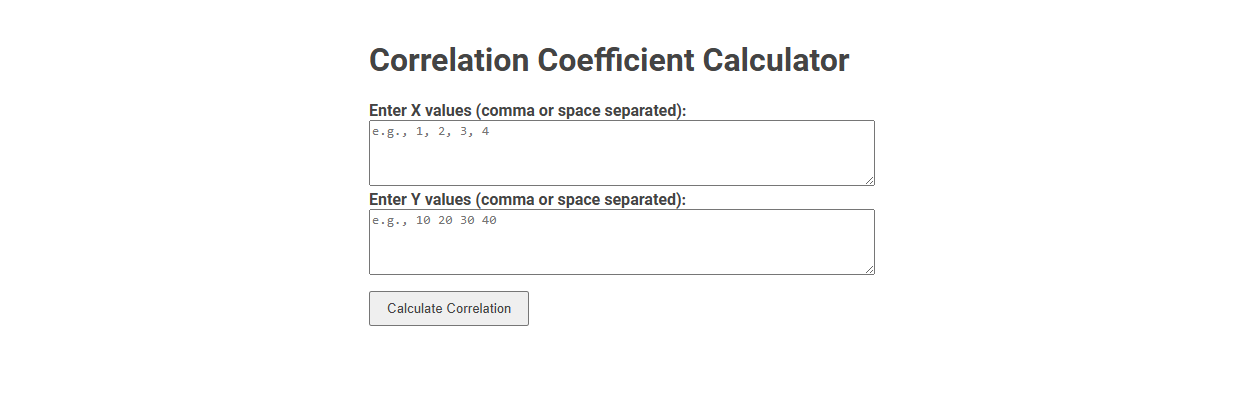
The Correlation Coefficient Calculator tool computes the statistical relationship between two sets of numerical variables (X and Y values) to determine their strength and direction of association. It is essential for data analysis, statistics, research, and academic purposes where understanding the linkage between variables is required. Users input two corresponding datasets separated by commas or spaces, and the tool instantly calculates the correlation coefficient to quantify their relationship.
How to use this tool?
Complete Guide: How to Use the Correlation Coefficient Calculator Tool
-
Access the Calculator
Open the web page with the "Correlation Coefficient Calculator" tool. -
Prepare Your Data
Have your two sets of numerical data (X values and Y values) ready. Each set should contain the same number of values, and each X value should correspond to a Y value. -
Enter X Values
In the field labeled "Enter X values (comma or space separated):", type or paste your list of X values. Values can be separated by commas or spaces.
Example input:1, 2, 3, 4or1 2 3 4 -
Enter Y Values
In the field labeled "Enter Y values (comma or space separated):", type or paste your list of Y values. Use the same format as for X values.
Example input:10, 20, 30, 40or10 20 30 40 -
Check Data Format
Ensure both the X and Y value fields contain the same number of entries. Each entry should be a valid number. Do not include letters or symbols. -
Calculate Correlation
Click the button labeled "Calculate Correlation". -
Read the Result
The tool will display the calculated correlation coefficient. This value indicates the strength and direction of the linear relationship between the two datasets:- +1: Perfect positive correlation (as one increases, so does the other)
- 0: No linear correlation
- -1: Perfect negative correlation (as one increases, the other decreases)
-
Interpret Your Result
Use the displayed correlation coefficient to analyze your data relationship. For further analysis, repeat the steps with different datasets as needed.
Troubleshooting Tips
- Make sure there are the same number of X and Y values.
- Check for typos, extra spaces, or non-numeric characters in your entries.
- If the calculation fails, re-enter your data carefully and try again.
Introduction to Free Online Correlation Coefficient Calculators
A free online correlation coefficient calculator allows you to quickly measure the strength and direction of the relationship between two variables. This tool uses statistical formulas like Pearson's or Spearman's correlation to provide accurate results without manual calculations. Your data analysis becomes more efficient, supporting better decision-making in research or business projects.
Key Features of Online Correlation Tools
Correlation coefficient calculators offer quick, accurate measurement of the statistical relationship between two variables using Pearson, Spearman, or Kendall methods. Key features include user-friendly input options for datasets, real-time computation with graphical scatterplot displays, and downloadable result reports. Advanced tools support multiple data formats, handle missing values, and provide detailed interpretation to aid data analysis.
Step-by-Step Guide: Accessing the Calculator
Access the correlation coefficient calculator by navigating to a trusted statistics tool website or downloading a dedicated statistical analysis app. Input your paired data sets accurately into the designated fields ensuring each value aligns correctly for precise computation. Click the "Calculate" button to instantly receive the correlation coefficient, interpreting the strength and direction of your data relationship efficiently.
How to Prepare and Format Your Data
Preparing your data for a correlation coefficient calculator involves organizing your variables into two columns with corresponding data points aligned by row. Ensure each dataset is numeric, free of missing values, and follows a consistent scale to maintain calculation accuracy. Proper formatting includes labeling columns clearly and removing outliers to achieve reliable correlation results.
Inputting X and Y Values Correctly
Accurately inputting your X and Y values is essential for reliable results in a correlation coefficient calculator. Ensure data pairs correspond correctly to maintain the integrity of the statistical relationship. Proper alignment of these values guarantees precise calculation of the correlation strength between variables.
Ensuring Data Validity: Common Formatting Issues
A Correlation Coefficient Calculator requires properly formatted data to ensure accurate results, as common issues like inconsistent decimal symbols, missing values, or mixed data types can distort calculations. Valid data preparation includes standardizing decimal separators, removing empty cells, and verifying numeric entries. These steps eliminate errors and enhance the reliability of correlation analysis outcomes.
Executing the Correlation Calculation
Executing the correlation calculation using a correlation coefficient calculator involves inputting your data sets accurately to obtain precise results. The calculator processes the paired data points to determine the strength and direction of the linear relationship, providing you with a correlation coefficient value ranging from -1 to 1. This value helps quantify how closely your variables are related, guiding further statistical analysis.
Understanding and Interpreting Correlation Outputs
A Correlation coefficient calculator helps you quantify the strength and direction of the linear relationship between two variables. Understanding the output involves recognizing values close to +1 or -1 indicate strong positive or negative correlations, while values near 0 suggest weak or no linear relationship. Interpreting these results accurately guides effective decision-making in data analysis and research.
Practical Applications in Data Analysis
A Correlation Coefficient Calculator enables precise measurement of the strength and direction between two variables, crucial for data analysis. This tool supports you in identifying patterns, testing hypotheses, and making informed predictions across fields such as finance, healthcare, and social sciences. Leveraging accurate correlation metrics enhances the reliability of your analytical insights and decision-making processes.
Correlation coefficient calculator Tool Preview